This Week at Liberty
September 22, 2026

Hoots, Howls, and Hollers
Megan Mosby
Executive Director
Diversity and Habitat Reign
As wildlife enthusiasts, at least I assume you are one if you are following this blog, I am sure you understand two basic principles of protecting wildlife and the role wildlife plays in this world…habitat and diversity. Habitat, or a suitable home, is about as basic as you can get. You have to have a place to live, make a living, raise a family in order to survive and thrive as a species. Looking closely at the causes of extinctions of species one finds loss of suitable habitat as one of the leading causes. Loss of diversity is closely related with all of its damning properties. If a creature is looking for habitat in a small cafeteria of potentials, the resulting competition for habitat leads to losers and those losers result in loss of diversity. Loss of diversity is basically a loss of possibilities. We don’t know what we don’t know about wildlife and how it has evolved to survive and how those learnings can help us survive. For example, Gila monsters secrete a material that helps diabetics. Plant seed burrs have methods for pollination and dispersal by sticking to animal furs and being transported and spread successfully in their efforts to survive and thrive… fyi Velcro mimicked this behavior. Biomimicry teaches us that we have so much to learn from studying the successes of other plants and animals. This leads me to an interesting story that has recently been drawing attention with the likes of Jimothy, the neckless raccoon and Jackie, the Big Bear Bald Eagle.
Enter Tilcayo. This wild cat, smaller than our domestic cat, replete with leopard-like spots and endearing rounded ears weighing 3 pounds and 18 inches from head to base of the tail, was found by a family in Boliva in the Yungas region near La Paz. The likes of this little cat haven’t been seen since 1923. The family turned him over to a sanctuary after all attempts to make him a “pet cat” failed.
When it was realized that the rarity of the cat’s existence was an important discovery, a complete genome sequencing was undertaken. At that point the uniqueness of the cat was discovered. Before this, the species was not recognized, and it appears that this lineage split had occurred around 1.4 million years ago. There is so much to learn about this ‘new’ species…what is the diet, the range, behaviors, etc. It is hoped that this designation as a new species will help protect the habitat in which it exists. Deforestation is happening all around the area due to the impact of gold mining.
Jonas Lescroaet from the University of Antwerp further explained “We should make haste in doing these kinds of discoveries, because all of this biodiversity is under pressure and its disappearing as we speak.”
We don’t know what we can learn from studying this new member of the cat family. We don’t know what connections exist between this new species and others surrounding the area. We don’t know what we don’t know. And, if it disappears, we will never know what we might need to know. Protecting species and habitat ultimately protects us. Excuse me for being selfish, but I kind of like our world. Protect the Tilcayo and explore its significance.
Diversity and habitat reign. We ignore this at our own destruction.
This Week @ Liberty
The intake total for the year is now up to 10,600.
Pumpkin flavored everything is back and I am one hundred and ten percent here for it.
That’s it. That’s the only thing everyone needs to know (other than to go out and enjoy all the things life has to offer, of course, because the weather is getting exponentially better every day. I think our wildlife is feeling it, too)!
By: Acacia Parker | Public Outreach Coordinator
Neighborhood Friends
I have to admit my morning walks have been amazing with these cooler(ish) temperatures. I can breathe again! I’m not sweating the moment I walk out the door! My pups are so excited about life and all the bunnies they can see but can’t chase! Life, for the most part, is good again, and I know this because it seems like all the wildlife in my neighborhood is feeling it too. Hence the reason I’m writing about our neighborhood friends, because if I’m seeing all kinds of things on my two-ish-mile walk, I assure you, you will, too!
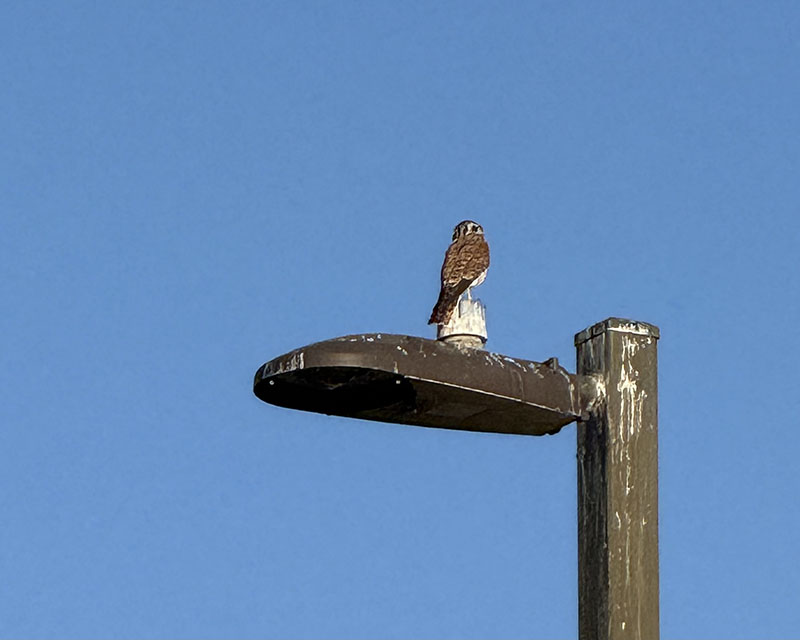
The first new friend: a loud, boisterous, female American kestrel. I heard her before I saw her; usually, this tends to be true for these guys (at least, for me!). They’re North America’s smallest falcon. Unless you’re really looking, it’s incredibly easy to overlook them. The easiest way for me to identify them is that head bob (they do this to help with their depth perception and judge distances), the flick of their long, brown tails, and their noisy klee-klee-klee call! They like to hang up high on streetlights, saguaros, trees…anything where they can chill for a bit and look for their prey (small rodents like mice and bugs). And if you’re wondering how I knew this new friend was a female, the wing color is the giveaway; the females have the rufous brown wings, whereas their male counterparts are a steel-grey blue.
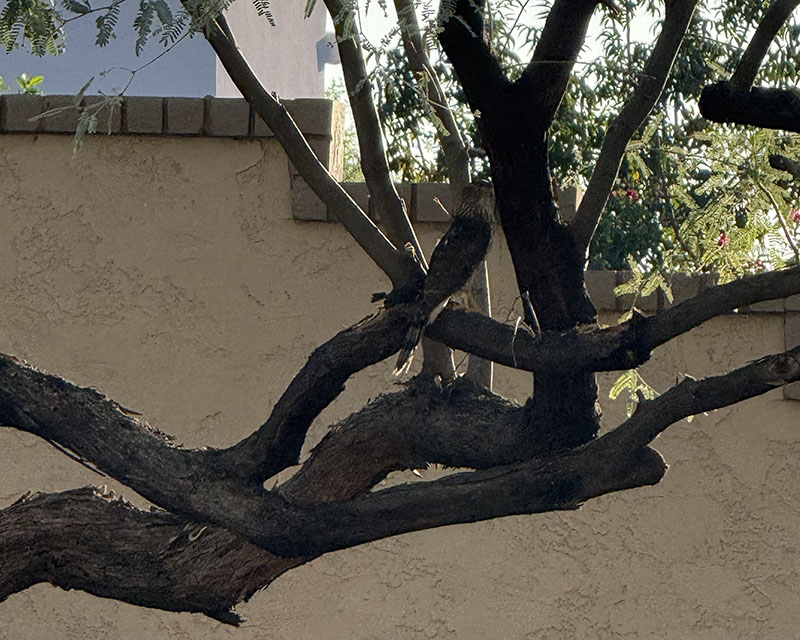
Onward, to our second friend: a Coopers hawk! These accipiters are fast flying hawks who like to weave between trees to catch other birds. They’re super common in woodland areas, but we have a lot here in the Phoenix area, too (A lot of the summer kiddos who are brought to us are, in fact, Coopers hawks)! These guys are smart, too; if you have a bird feeder in your backyard, they will purposefully wait until there are doves, pigeons, and other various birds there to swoop down low and scare them in the hopes one will hit a window (or something along those lines), which leaves their prey stunned, and voila; an easy meal has been had.
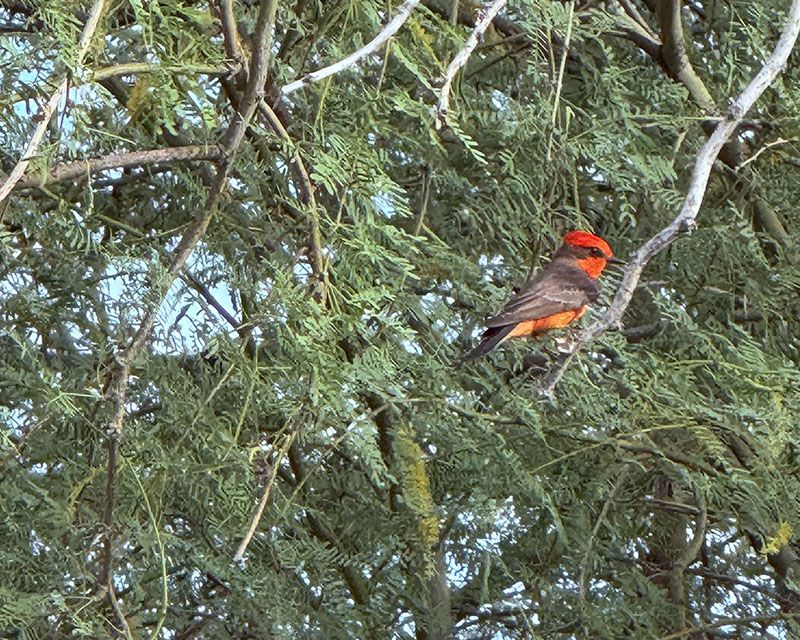
And last but not least; a vermillion flycatcher! A male, at that! This little guy LOVES the park down the road by my house. It’s filled with all kinds of flying insects for him to eat; hence the reason I usually don’t see him anywhere else but that park. That’s how they hunt; they sit, waiting, until they’re ready to go, then they’re off with a short, direct flight to catch said bug, then they’re back on that perch eating and waiting for another.
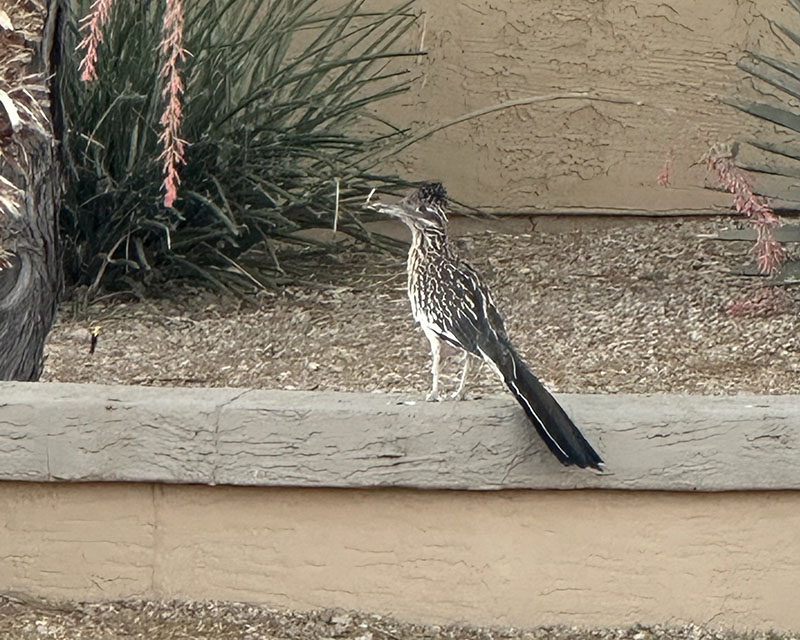
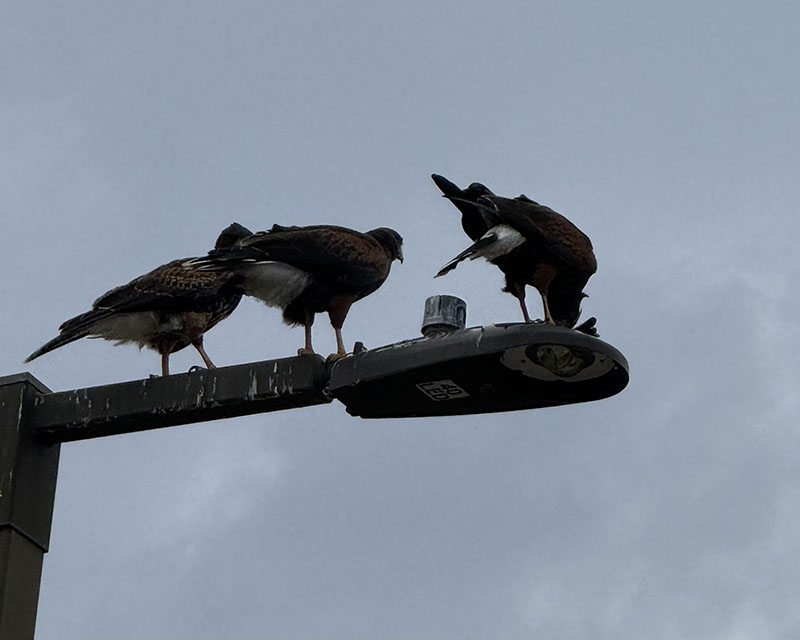
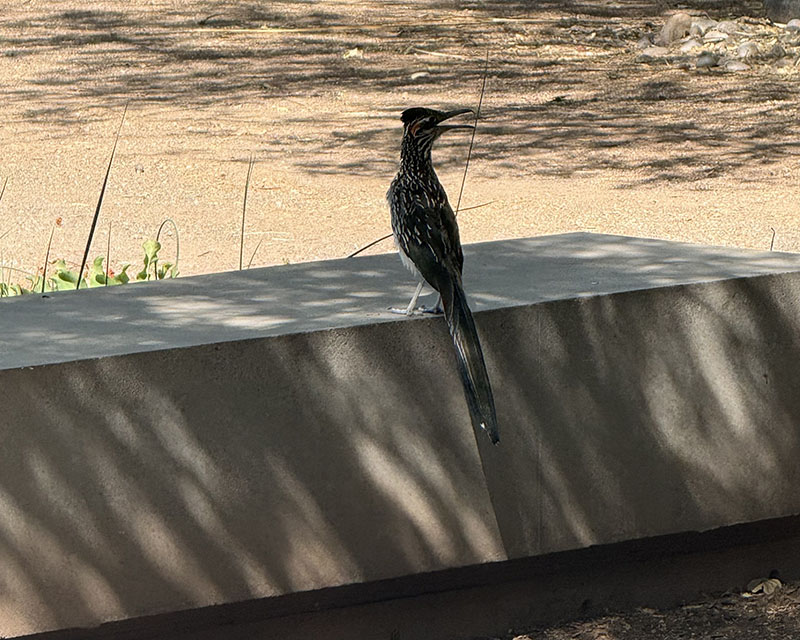
Some notable mentions I’ve seen throughout this year when the weather has cooled off: a coyote, a gopher snake, a greater roadrunner and a family of Harris’ hawks!
So, if you’re wondering what the point of this whole thing is, it’s to keep an eye out for what YOU might see out there. I know it can be hard in the hustle and bustle of city life, but every once in a while when we slow down, it’s amazing to see what is surviving, and often times, thriving, right around the corner.
By: Acacia Parker | Public Outreach Coordinator
Notable Mentions
You’ve made it! Public hours continues from 9am-11am on Wednesday, Saturday and Sundays and don’t worry, we’ll announce when our fall hours begin. Intake is open, rain or shine, from 8am-6pm and make sure to give our hotline a call at 480-998-5550 with any rescue questions you might have. We also have our annual fundraiser Wishes for Wildlife happening on Saturday, October 24th, so make sure to buy your tickets here!
Without further ado, here are this week’s notable mentions:
- Our resident greater roadrunner makes a drive-by at the wetlands (1 picture)
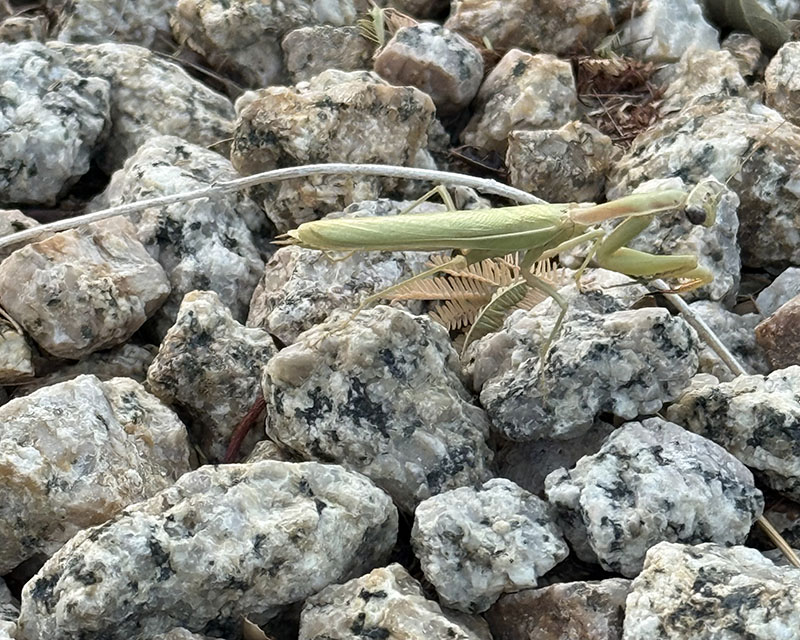
- A praying mantis heads to a tree for safety (1 picture)
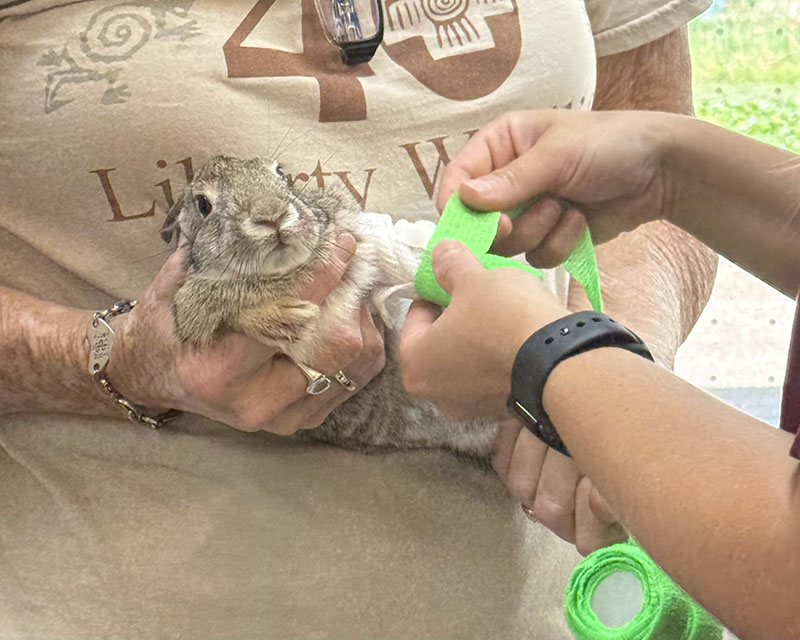
- Medical service volunteers assist in wrapping a desert cottontail’s leg (1 picture)
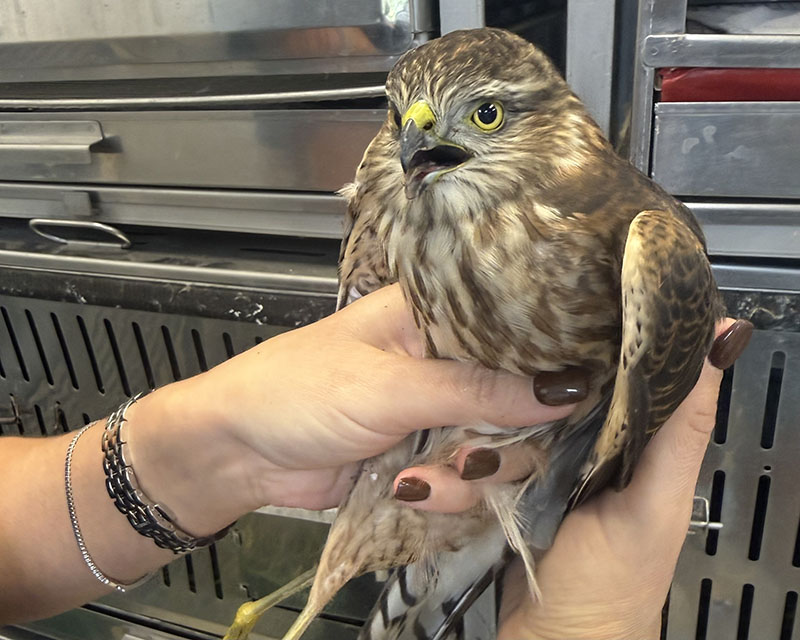
- A sharp-shinned hawk was found on the ground by a rescuer and brought in immediately for assessment (1 picture)
As always, thanks so much for being here and taking such good care of Arizona’s wildlife.
Until next time!
By: Acacia Parker | Public Outreach Coordinator
More Posts from Liberty Wildlife
May 6, 2025
The story of 24-7116, a female ferruginous hawk, began with us on July 2, 2024. She presented as a massive buteo, the largest of our soaring hawks.

© 2026 Liberty Wildlife - Privacy Policy