This Week at Liberty
December 16, 2025

Hoots, Howls, and Hollers
Megan Mosby
Executive Director
Nature’s Amazing Adaptations
Recently I was re-introduced to a beaky little fellow, the painted turtle. Okay, it wasn’t the first time I have seen one…in fact, these little species of turtle represented one of the first pets I ever owned. I am somewhat indebted to them as they taught me a lot about what to do and not do with an exotic pet found at the pet shop. Of course, I begged and pled until one was purchased for me…and unfortunately, sacrificed unknowingly, to ignorant and insufficient care. I have some bad karma in the animal world which I am trying desperately to work off. My painted turtles died before their time. It was undoubtedly my fault.
This was brought home to me when a clip about the most northern painted turtle was sent to me by someone who knows of my fascination with animal adaptations to withstand the torrents of weather’s demands. In the clip from a BBC program there is an introduction to the painted turtle, the most widespread turtle found around our world, all very different in their needs to adapt to the harshness of the climate they live in.
Frozen in Time
During the cold winters of the northern part of the continent soon after they hatch in the late summer, in preparation for the frozen winters, they dig into the mud at the bottom of the local pond and begin hibernating for months. Then in spring when the snow melts, it frees them from the suspended animation that they have existed in. Okay, that might not impress you, but I am holding back some important information. As they do this, their systems slow down to the point where their hearts stop beating; clearly the lungs aren’t pumping. Their cheeky little beaky faces are stilled, eyes closed, legs suspended as if they died on the scene…with no signs of life…little frozen turtle popsicles…with barely a brain wave functioning…barely… but there.
When the ice and snow begin to melt, a miracle happens. A leg stirs, an eye blinks slowly open, the head pokes out of the carapace and the signs of life stir. The little painted turtle hatched shortly before, who went into icy slumber until the first of spring appears, now pulls itself up, emerges from the once frozen pond and lumbers back into the real world sooner than other species, to feast on the bounties provided by the forest. How do they do it? Students of biomimicry should look closely at this adaptation. I am fascinated.
A Desert Adaptation
In our own hostile desert environments, the hot, dry summers provide similar challenges for the spadefoot toad (which is really a frog). Spadefoots have developed their own form of adaptation that demands that they dig their ways in to an underground sanctuary to await the pitter patter of monsoon rains signaling to them that it is time to get on with the business of mating and spawning new spadefoots…and the time is limited to the length of the period that water stays in the pool. The life cycle from tad pole to spadefoot frog is shortened to a few days in order to successfully continue the species. An amazing adaptation to the harsh conditions, and short-lived wetness after a rare desert storm.
A Call to Care and to Adapt Ourselves
In both of these cases it is easy to see how hard survival could be; how important that the natural world continue its normal patterns, and continue to provide the things necessary to these fragile threads of existence.
It is dependent on us to do whatever we can to ensure that these adaptations continue to work for these species. And coincidentally, for all of the other species that depend on them to fulfill the role they play in our connected world.
We might start thinking about what adaptations we need to work toward to ensure our own existence…not sure what that is…but it is a thought! Are we clever enough to know when to shut down and wait for things to change in our favor or are we not?
My apologies to all of the little creatures sent to me over the years to satisfy my awe of nature…so many did not get the opportunity to realize their purpose. But they did provide inspiration. And now, I am trying to make amends and to un-tarnish my karma. My complete awe of the natural world has inspired me to pass on as much as I can to anyone who will hold still long enough to listen. Thanks for reading/listening to the end!
This Week @ Liberty
The intake total for the year is now up to 9145.
I can’t believe it, but just one more blog to write and then it’ll be 2026! I’m happy to say I’m all done with my holiday shopping (except for my husband…he’s always my hardest) and we have lots of plans between now and Christmas to see family and enjoy the spirit of the holidays. I am oddly enjoying the warm-ish afternoons as well, simply because it goes right back to being so cold once the sun sets.
I hope you’re all enjoying the last of your 2025 and wrapping up what turned out to be an interesting year. We only have a few more weeks, then we’ll be on to the next one!
By: Acacia Parker | Public Outreach Coordinator
Bird Behavior
When you spend time with any one creature (humans included), you find they each have their own unique habits. My teenage niece has developed a fun eye roll when she thinks something is lame. My golden retriever Finn has a very specific prance when he grabs something he isn’t supposed to have. And I, unfortunately, have developed subtitles (aka I am not good at hiding my emotions, you can usually see how I’m feeling written all over my face).
This behavior is the same for birds. There are some that are similar throughout the species, and there are some unique to each animal. And while I can’t go over all the fun behaviors, here are some I have learned to enjoy while being at Liberty Wildlife.
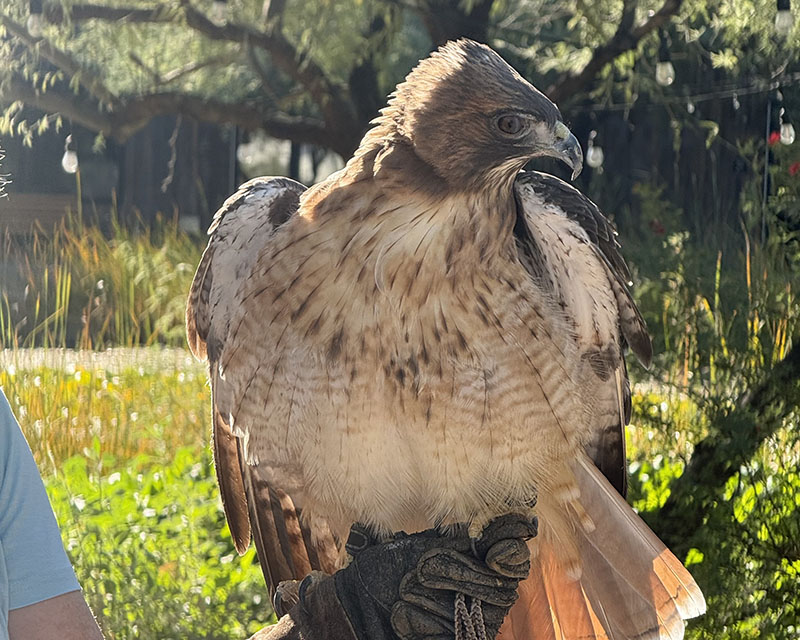
- Rouse or rousing: this is when a bird lifts its feathers and shakes those feathers away from its body. This helps to clean, rearrange and align, which also helps to remove debris and any excess water. We’ve posted many a video on our social media to showcase this behavior, and I, of course, have taken many a photo! This is a fun behavior because it means the bird is relaxed and comfortable!
- Feaking: if you’ve ever noticed a bird rubbing it’s beak on a hard surface (perch or glove or something along those lines) that is the bird cleaning it’s beak of food after feeding.
- Gular Flutter: birds don’t have sweat glands like we do; if you’ve seen a great horned owl open mouth breathe (and that little part beneath its throat move in and out) that is the bird cooling itself off. It’s very similar to how your dog pants!
- Mating dance: every bird does this a little differently. Red-tailed hawks will soar around each other high in the air, lock talons and “fall” in a dizzying circle before releasing each other. California condors will preen, offer displays to one another, and coordinate their flights. Common ravens will dive, roll or talon lock, offer food gifts, or preen each other. Like I said, there’s all kinds of different ways to attract a mate!
- Mantling: this occurs when a bird of prey spreads their wings to cover a captured meal (to protect it) or simply because they are offering a warning to someone that they’re getting way too close!
What’s even more fun is that you’re able to see these behaviors up close. Public hours are happening every Wednesday, Saturday and Sunday from 10am-1pm. During these times, our volunteers showcase many of our birds, and you can see many of these behaviors here on-site. So, make sure the next time you visit, and you see one of our feathered friends do some fun behavior, to call it out or ask a handler what that behavior is!

Notable Mentions
Well, we only have one more of these so let’s make it count! Without further ado, here are this week’s notable mentions!
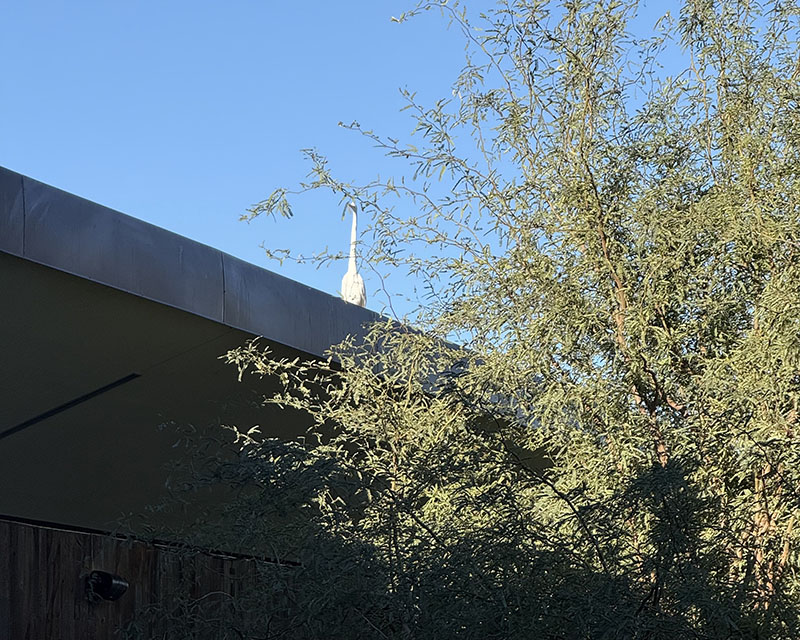
- A great egret does a quick layover on the roof of Liberty Wildlife, all while perusing the wetlands below (1 picture)
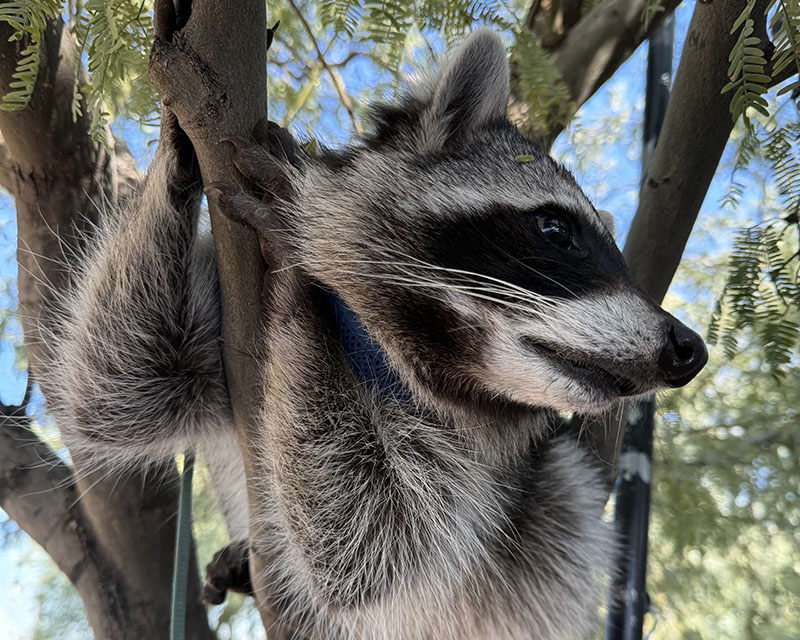
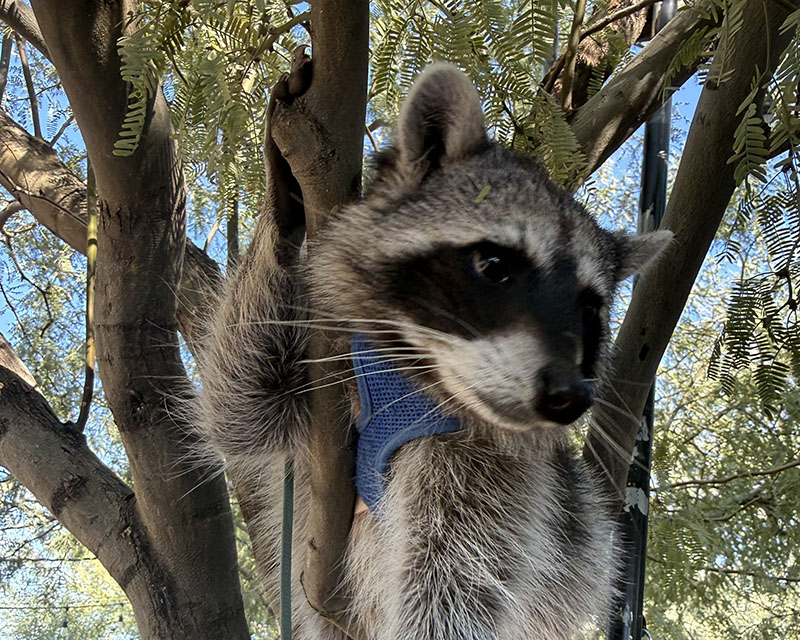
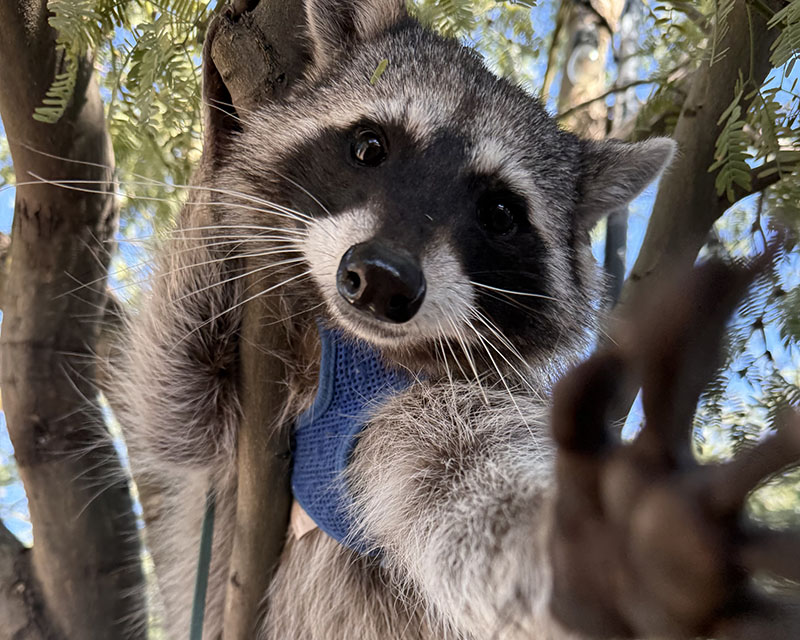
- Benji the racoon being way too adorable for his own good (3 pictures)
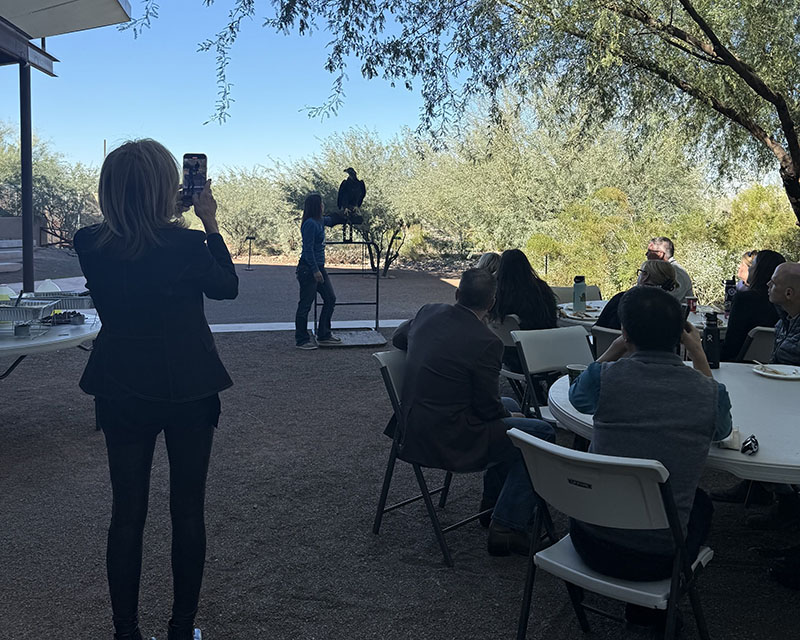
- Laura presents Cisca the bald eagle to an event on-site (1 picture)
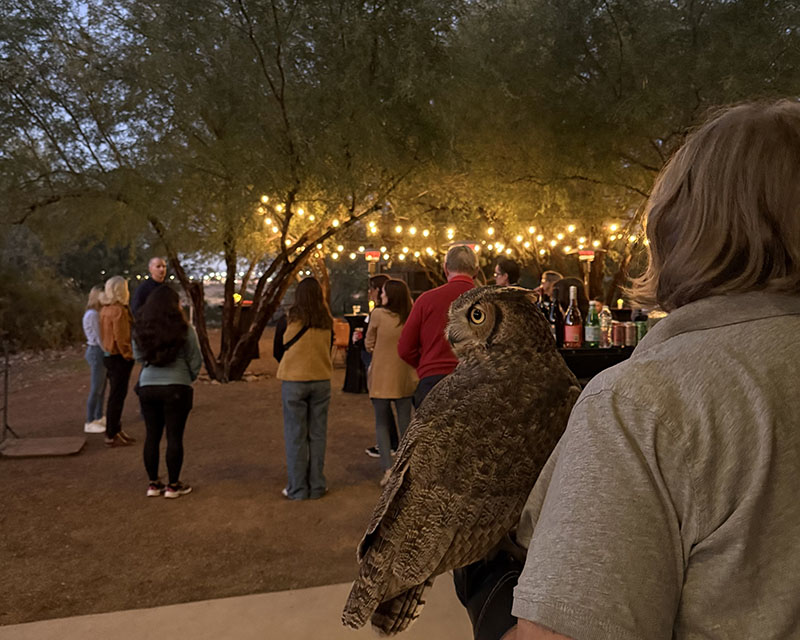
- So many events throughout the month of December! This was a happy hour in the upper mesquite with finger foods and appetizers (1 picture) (Explore more about booking an event at Liberty Wildlife!)
It’s hard to believe we’re almost at the end of another year, but alas, that is the way the world works. Thanks so much for reading and being here with us. Remember our intake is open 7 days a week, rain or shine, from 8am-6pm. We will be closed on Thursday, December 25th; you can either go to VEG, keep the animal in a warm, dark, quiet place until Friday, December 26th, or call our hotline to find out more information.
Until next time!
More Posts from Liberty Wildlife
December 17, 2024
Every year, I tell myself I’m going to start shopping for the holiday in November so I’m done in December and all that’s needed is to wrap. Well, like most every year before this, that definitely didn’t happen.
December 30, 2025
As a young student, many years ago, I was fascinated by Greek and Roman mythology.

© 2026 Liberty Wildlife - Privacy Policy