Nature News
September 30, 2026
Nurturing Nature
By: Carol Suits
Liberty Wildlife Volunteer
Kid Stuff philosophy: The screen is the launch pad. The real activity happens outside – where kids can observe, wonder, create, solve problems, and become helpers for nature.
The Night Shift
When night things take over!
Owls hunt. Bats search for insects. Tiny mammals leave their burrows. Moths visit flowers. Coyotes and other night animals move through the darkness. On some nights, birds from far away fly overhead on a long migration journey!
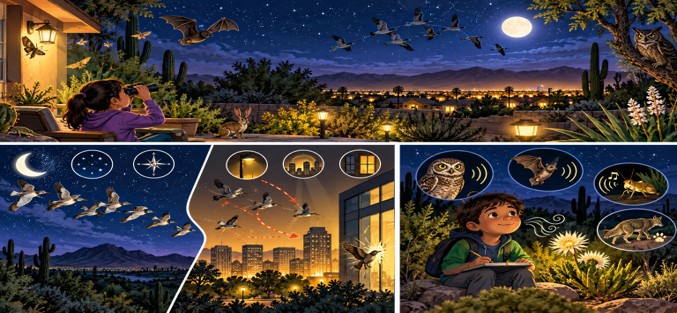
Some animals hide. Others come out!
Night Explorer Challenge
Choose a safe place – your yard, porch, balcony, or a window with a view outdoors. Spend 5-10 quiet minutes after dark. You do not need to find an animal. Your job is to find proof that the night is alive.
■ What is the brightest thing you can see? What is the darkest place you can see?
■ What is the farthest sound you can hear? What is the closest sound?
■ Do you notice movement you did not see at first?
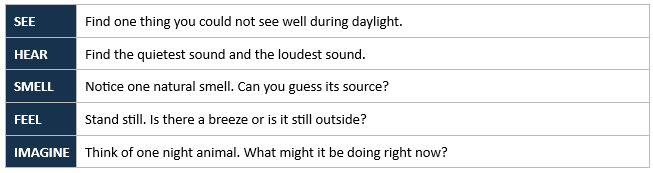
The 5-Sense Night Challenge
Create Your Own Night Creature

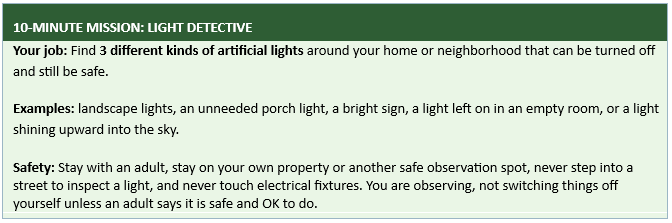
When Lights Change the Night
Artificial light can make our streets and homes safer – but extra light can also change nighttime conditions for wildlife. Migrating birds can be attracted to bright lights and become disoriented around lighted buildings that can pull birds into places where windows and other structures can create harm.
Migratory Birds
The night sky can be very busy! Many migratory birds travel at night. Billions of birds migrate in the spring and fall. Do you want to know whether bids may be migrating over your area tonight?
Check out https://birdcast.info/migration-tools/migration-dashboard/
Be a Night Helper
Decide what you can do!

Puzzles and Downloads!
Happy end of September! Enjoy a puzzle to wind down for the day! Plus, download Nature News: Kids’ Stuff to save the fun for a future date!
For Adults
The activities in this article are designed for observation from a safe location. For a window-collision victim, contact a qualified wildlife rehabilitator for instructions.
SOURCES & FURTHER EXPLORATION
Cornell Lab of Ornithology / All About Birds: “The Basics of Bird Migration: How, Why, When, and Where” (updated April 2026). Most birds migrate at night; discusses nighttime travel and migration threats.
- Cornell Lab of Ornithology / All About Birds: “Why Birds Hit Windows – and How You Can Help Prevent It” (current page). Explains the role of artificial light at night and why many collisions occur at dawn/day because of reflections.
- BirdCast: https://birdcast.info/migration/ – migration forecasts, live maps, dashboards, and local migration information.
Winter Nesters
By: Gail Cochrane
Liberty Wildlife Volunteer
In December you find many humans stringing glittering lights, drawing up gift lists and attending holiday parties. In the parallel universe of nature, a few species of wild birds are already making equally fevered preparations for mating season. These desert species find it advantageous to breed in the winter months, and experts see the season getting earlier every year.
Great horned owls are among the most conspicuous early nesters, hooting repeatedly at dusk and dawn, advertising their territories and wooing mates. It’s a bit of a misnomer to call this impressive predator a nester though, as great horned owls generally don’t build nests. Instead, they make use of nests built by other species, often red-tailed hawks. The hawks will be nesting soon though, so it’s a good plan for GHOs to move in early.
In urban and suburban areas of the Valley of the Sun, palm trees and man-made structures often provide what seem to be ideal nesting ledges. But these nest sites may lead to trouble when the fledglings begin “branching”. Great horned owl fledglings get adventuresome and start pushing and shoving a bit in the nest as they grow, often ending up on the ground. The parents continue to feed and guard them during this awkward stage, but if there is a busy street or other hazardous situation nearby, a baby owl may require rescue.
Great horned owls mate for life and hold the same territory year after year if possible. Courtship begins in late November or December, with the two owls bowing to each other and hooting duets. The male brings tasty morsels to the female in attempts to further impress. Sometime between January and March the eggs are laid and the female settles in to incubate while her mate takes over hunting duties.
Another December nester from the opposite end of the size spectrum is Anna’s hummingbird. This tiny bird engages in dynamic courtship displays, with the male hovering, giving a buzzy song, then shooting high in the sky before diving back toward the female. He may also zoom back in forth in front of her, impressing his potential mate with his stellar flight abilities.
Anna’s that winter in cold weather areas benefit from the extremely well insulated nests they build. Temperatures inside the nest can be 40 degrees warmer than outside. This keeps the eggs warm and helps the female conserve energy. Within two weeks of hatching a baby hummer has grown a downy coating of feathers that allows it to maintain its own body temperature.
Other winter nesters begin the mating process in January and February, including Harris’s hawks, red-tailed hawks, barn owls, Costa’s hummingbirds and members of the dove family.
*Previously published in December 2024


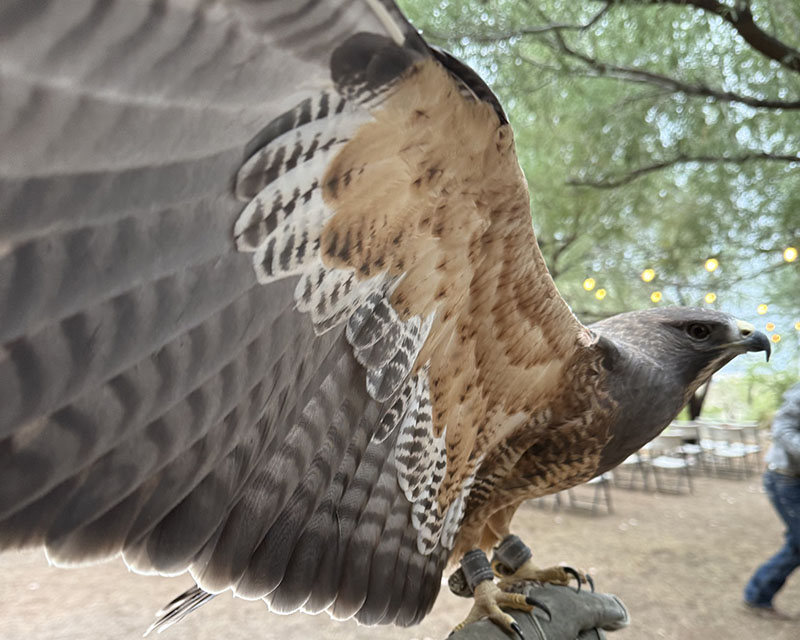
MEET OUR EDUCATION AMBASSADOR!
By: Claudia Kirscher
Liberty Wildlife Volunteer
The Swainson’s Hawk is a widespread hawk of Western North America during spring and summer. Every autumn, it does one of the longest hawk migrations south for the winter to as far as Argentina and returns to North America to its spring nesting grounds….a 12,000-mile round trip! They may also winter in Mexico and Central America. These hawks are one of the rare raptors to migrate in large flocks, sometimes numbering in the hundreds or thousands.
They favor open plains, grasslands, and agricultural areas foraging for insects, small rodents, lizards, and small birds. Swainson’s Hawks are often seen following tilling tractors grabbing ploughed up insects and rodents. There are two color variations, light and dark morphs.
Their populations have declined due to habitat loss of agricultural lands to housing development and use of pesticides.
Liberty Wildlife has 2 non-releasable Swainson’s Hawks
Addison arrived in 2021 as a 1st-year bird from Yuma, AZ. She had folding fractures due to poor nutrition in captivity plus habitation. She has not yet molted into her full adult plumage.
Cassidy came to us in 2020, a 1st-year bird, from Sierra Vista, Az. She had been caught in barbed wire, broke her wing, and showed signs of an electrical injury which required subsequent partial wing tip amputation.
Come on down to visit and hear their stories!

More from Nature News
© 2026 Liberty Wildlife - Privacy Policy