Nature News
June 30, 2026
Nurturing Nature
By: Carol Suits
Liberty Wildlife Volunteer
Kid Stuff
Have you ever wished you had a superpower?
Maybe you would like to see in the dark, run super-fast, or stay cool on a hot day.
Guess what? Wildlife has superpowers!
Scientists call these special survival tools adaptations. An adaptation is something that helps a living thing survive where it lives.
Let’s meet some amazing animals and discover their natural superpowers!
Amazing Animal Adaptations!
How Wildlife Survives with Natural Superpowers
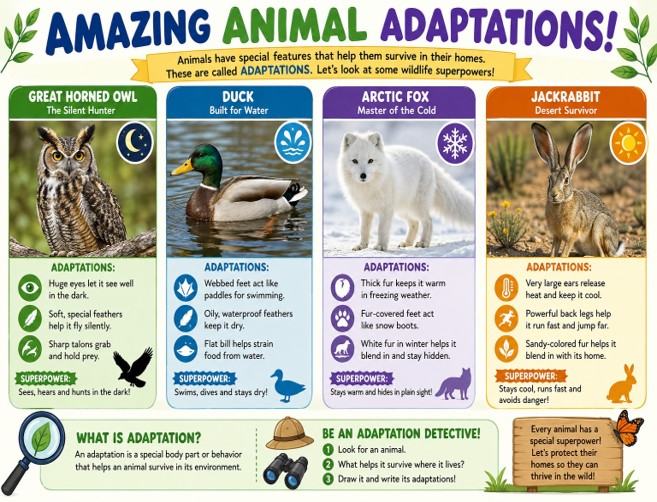
Great-Horned Owl
A great horned owl uses huge eyes and silent feathers to hunt at night.
Imagine hearing a mouse moving under leaves from across a playground! That’s one of an owl’s amazing superpowers.
Try It! Have a friend crumple paper while you close your eyes. Can you point to where the sound came from? Owls use their hearing even better than you can!
Duck
A duck has webbed feet and waterproof feathers for life in the water
Arctic Fox
An Arctic fox stays warm with thick fur and changes color to blend into its habitat.
Jackrabbit
A jackrabbit uses its giant ears to release heat and stay cool in the desert.
Be a Adaptation Detective
Try being an Adaptation Detective! Look for an animal and ask yourself:
What helps it find food?
What helps it stay safe?
What helps it survive where it lives?
Celebrate the 4th of July with your wildlife friends!
Here are some patriotic-colored natural and blended wildlife foods:
- Red:
- Berries: Raspberries, strawberries, and dried cranberries are excellent for songbirds and small mammals.
- Seeds: Safflower seeds and red milo
- White:
- Seeds: White proso millet, hulled sunflower seeds, and peanuts.
- Nuts: Raw, unsalted almonds and walnuts (great for squirrels).
- Blue:
- Fruit: Blueberries are a natural, high-energy favorite for backyard birds like bluebirds, robins, and thrashers.
- Grains: Blue corn and purple/blue kernel corn.
Puzzles and Downloads!
Happy end of June! Enjoy a puzzle to wind down for the day! Plus, download Nature News: Kids’ Stuff to save the fun for a future date!
Drought brings Repurposing
By: Gail Cochrane
Liberty Wildlife Volunteer
Over the years the area of our yard graced with lawn has been pared away. What now remains is a donut shaped ring around a central planting of hummingbird friendly natives. Since water is applied to the ring of Bermuda grass quite begrudgingly, it is more brown than green and studded with bare patches.
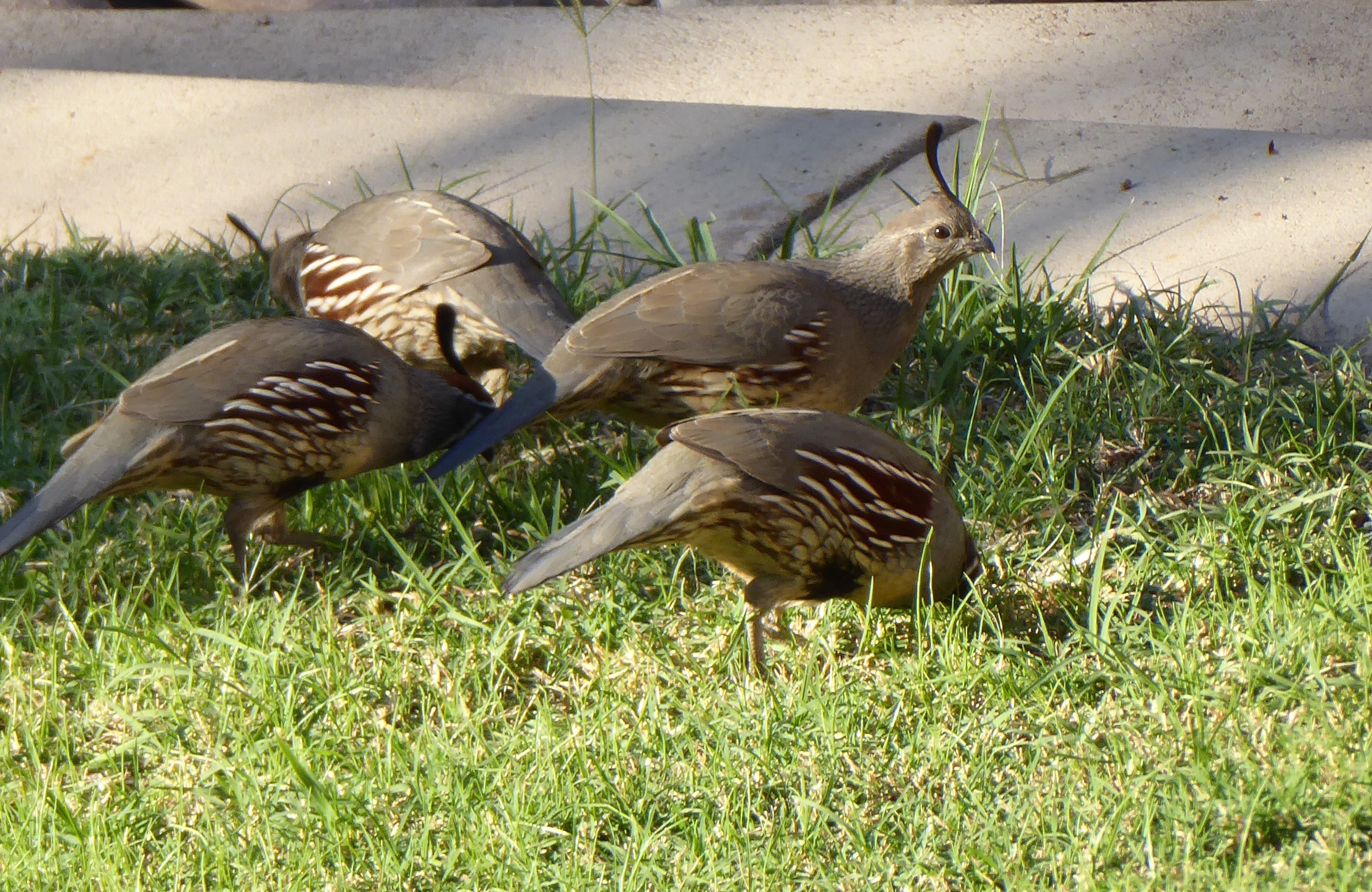
Even in its diminished state the Bermuda grass attracts grazers and probers. Gambel quails, a young cottontail rabbit, and a couple of curved-bill thrashers can be seen most evenings lately, sharing the small plot. This is rare green fodder for the herbivores, and a trove of insects to be extracted for insectivores. The quails are particularly endearing, as this time of year there are youngsters.
Those bare patches in the sparse lawn are big attractions as well. They are perfect for dust baths. Quails enjoy a daily dunking in a dusty plot, and the practice serves the birds well. Dust baths carry oils away from the birds’ feathers, restoring their condition and their ability to shield the birds from the effects of the hot sun. The quails sift the soft dust all the way to their skin where it further offers protection from parasites.
Quails are social birds, and bathing is no exception. Usually several of the lawn’s bare spots are occupied. The first thing that happens is a big scratching and loosening of the soil. Plumes of soft dirt are kicked up. The next thing you know the birds have flattened themselves in the silt and splayed their feathers. They roll from side to side, even onto their backs, shimmying and wallowing in the dirt. Sunken in the dust, the quails are unrecognizable from their normal form and posture.
Then comes the big shake off and feather fluff. Excess oils are carried away and the skin is twitched free of the cleansing dirt. The quails appear to check in with each other, “Have a nice soak?” Fresh and clean, they soon trail one after another out of our yard and back to their desert home.
Wild Ungulates of Arizona
By: Claudia Kirscher
Liberty Wildlife Volunteer
An ungulate is a large mammal with hooves (odd- and even-toed) such as horses, rhinoceros, giraffe, cattle, sheep and deer. The toes or hooves are actually enlarged toenails.
Arizona is home to 5 unique species of wild ungulates: Deer, pronghorn antelope, bighorn sheep, collared peccary (javelina), and elk.
There are 3 species of deer – mule, white-tailed, and Coues.
Rocky Mountain Mule Deer
Our Rocky Mountain mule deer are known for their large mule-like ears with acute hearing, one of their chief defenses along with eyesight, camouflage, and running. They favor foothills, brush canyons, and deserts feeding on a variety of grasses, mesquite, and seeds. They will occasionally feed on moonlit nights.
White-Tailed deer
White-tailed deer live at higher elevations in the mountains. In the Americas, it is the most widely-distributed wild ungulate. It has a characteristic white underside to its tail which it raises when alarmed to warn the predator that it has been detected.
Coues Deer
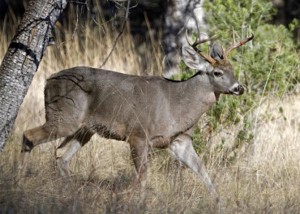
The Coues deer (pronounced “Cows” not “Cooz”) are called elfin deer, small, standing 32-34 inches at the shoulder, seldom exceeding 100 lbs. They are a subspecies of white-tailed deer. They favor elevations of 3500 to 9000 ft. Their large ears help to dissipate heat during hot summer months. Their breeding is timed to the monsoons so that June-born fawns have plenty of nutritious vegetation growth.
Pronghorn
The pronghorn lives on open plains and grasslands. Both sexes have forked horns which are shed each year. Their range is primarily in the north-central portion of AZ with small scattered herds in SE and SW AZ. The Sonoran pronghorn in SW AZ is considered endangered. They are the second-fastest land mammal (the cheetah is #1) with top sustained speeds up to 60 mph. To detect predators they rely on their excellent vision up to 4 miles due to large eyes and 360-degree peripheral field of vision. They are reluctant to jump and will crawl under fences.
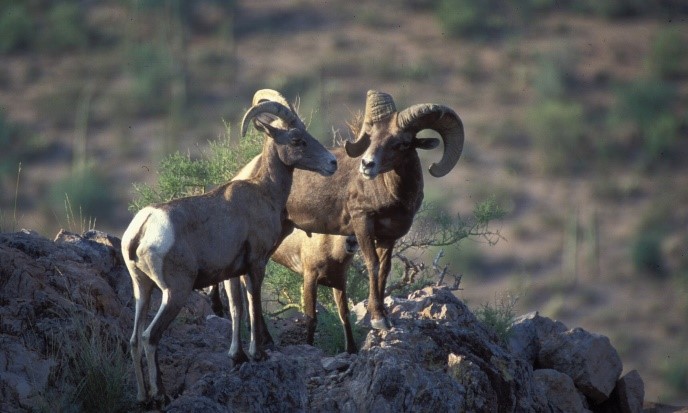
Bighorn Sheep
Bighorn sheep favor rocky desert mountain ranges, canyons, and precipitous slopes and cliffs to escape predators. They feed on grasses, mesquite, and agave. They will kick off the top of barrel cactus or butt horns against saguaros to get at tender moist flesh. Both sexes have horns, the male’s are curled and larger.
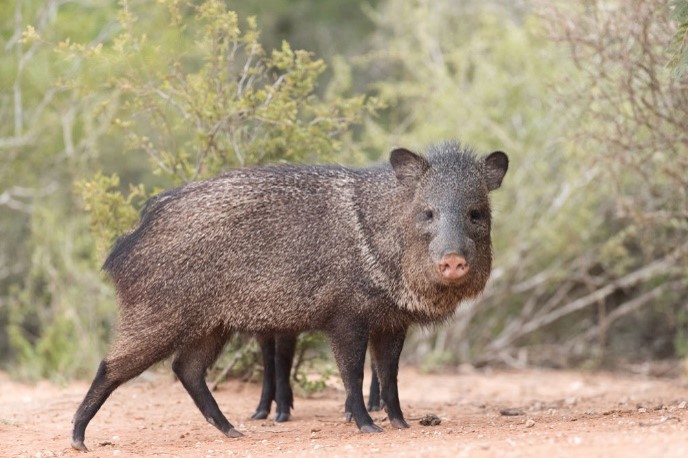
Javalina
The javelina resembles a small boar, weighing about 40-50 lbs. They have poor eyesight, an acute sense of smell, and long sharp canines (javelin/spear for which they are named). Not many predators other than mountain lions will attack an adult javelina. Babies do fall prey to smaller predators. All members of a herd have a communal smell. They are found throughout AZ favoring saguaro-palo verde areas feeding on mixed shrubs, cacti, tubers, and green vegetation. Twins births are common and babies are called “reds” due to their color.
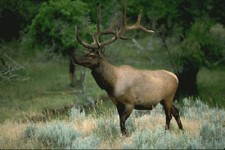
Elk
Elk stand up to 4-5 feet at the shoulder and can weigh up to 1100 lbs. Only the males grow antlers which can grow up to 4 ft above their head. They can run 30-40 mph. They are typically found in woodlands such as coniferous, aspen, and pinon-juniper forests. They feed on grasses, woody growths and even mushrooms. They form social herds run by a single female. In AZ they are commonly found in the White Mountains, Mogollon Rim, and Kaibab Forest.
More from Nature News
© 2026 Liberty Wildlife - Privacy Policy