Nature News
August 31, 2026
Nurturing Nature
By: Carol Suits
Liberty Wildlife Volunteer
Monsoons!
Did you see the desert monsoon storms this month? They were amazing! First the sky gets dark, the wind begins to roar, lightening flashes. Then—BOOM—thunder shakes the windows! Rain can pour down so fast, puddles and streams form.
So, what does a desert animal do when there’s a storm?
It has a plan!
Where would you go if you were a desert animal?
- 🐢 Duck into a burrow?
- 🦎 Hide beneath a rock or plant?
- 🐸 Come OUT because rain means it is time to eat and reproduce?
- 🐍 Stay sheltered until the worst of the storm passes?
- 🦇 Wait for cooler, wetter conditions before becoming active?
Some animals hide. Others come out!
Desert Tortoise
Hide! Shelter first! A desert tortoise’s burrow protects it from the heat and from bad weather. The tortoise will stay in its burrow until the storm passes.
Spadefoot Toad
Come out! Wake up! This guy is really amazing! Most of the time he lives buried underground where he can stay for months – waiting for the right conditions (rain!) to dig himself to the surface. He searches for pools of water, finds a mate, get eggs laid and tadpoles hatched. All that has to happen fast before the puddles dry up! WOW!
Rattlesnake
Drink the rain! Rattlesnakes can drink from puddles but what if the puddle dries up or there isn’t a puddle nearby? They can drink the rain that’s fallen on their scales. That rain doesn’t roll off the snake like water rolls off your skin. Instead, the snake’s scales have tiny channels that the water sticks to making it easy for the snake to sip up the water!
Behavioral Adaptions
Knowing when to hide, when to move and when to take advantage of the rain can make the difference between danger and survival.
Scientists call these kinds of actions behavioral adaptations.
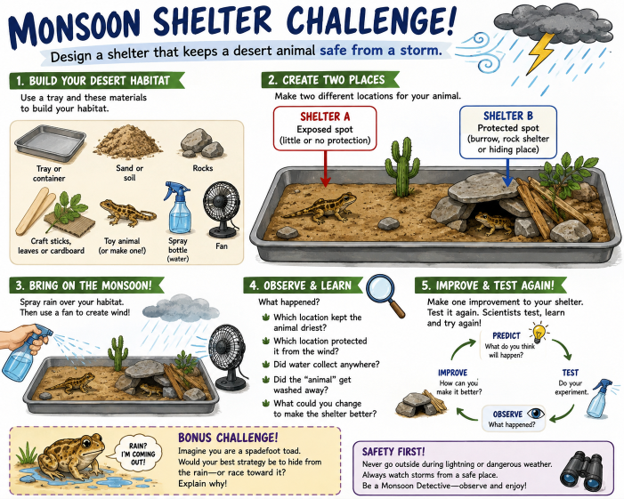
KID CHALLENGE: Build a Monsoon Shelter!
Can you design a shelter that protects a tiny desert animal from a pretend monsoon?
You’ll need:
- A shallow tray, baking pan or plastic container
- A little sand or dry soil
- Small rocks
- Craft sticks, leaves or pieces of cardboard
- A small toy animal—or make one from paper
- A spray bottle filled with water
- A fan
Become a Monsoon Detective
The next time a storm passes through, wait and watch from a safe space, then look for monsoon clues!
Water: Where did rain collect? Were there puddles or water flowing?
Animals: Did you see birds, insects, lizards, frogs, or other wildlife?
Plants: Did plants look different after getting wet?
Food: Were there more insects around?
Shelter: Did you spot a place an animal might have hidden during the storm?
So now we know that the Sonoran Desert can change a lot when the monsoons pass by and desert animals know exactly what to do!
Puzzles and Downloads!
Happy end of August! Enjoy a puzzle to wind down for the day! Plus, download Nature News: Kids’ Stuff to save the fun for a future date!
Three Owl Summer
By: Gail Cochrane
Liberty Wildlife Volunteer
In the past month I have seen three owls! And I’m not counting the beautiful and charismatic education ambassador owls at Liberty Wildlife.
I visited my brother in Olympia Washington recently. Deer graze in people’s yards and grey squirrels zip up and down the tall evergreen trees. At first light I walked through the watershed park, along a cushiony path winding beneath evergreen trees, crowded by undergrowth. Even the light seemed green. The owl flew up from the ground nearby. She had surely been eating something yummy that she had caught.
Like a shadow she rose to the branch of a tree. Swiveling her grey facial disk my way, she decided I was to be avoided. She lifted from the branch and sailed away, her wing tips reaching tree to tree. This is a barred owl.
Back home in Phoenix I often walk to an elementary and middle school complex nearby. On the south end, where water drains from under the campus, a dense stand of mesquite and Palo Verde trees flourishes in a deep wash.
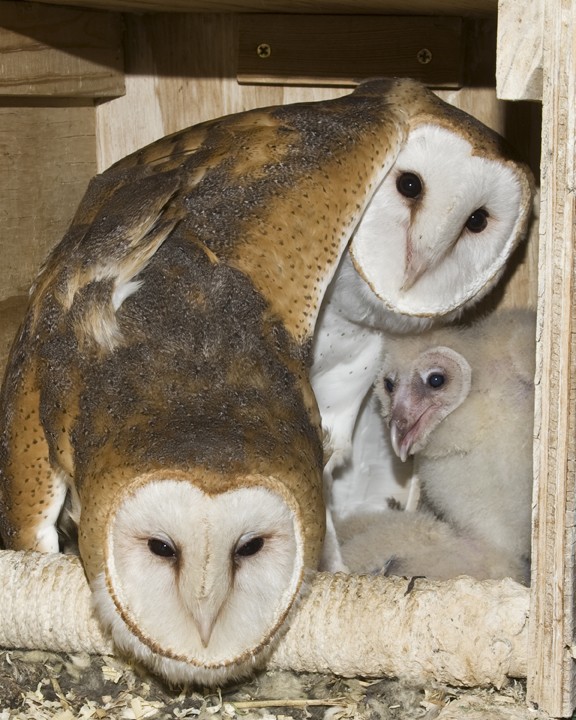
On an early weekend morning the dog and I skirted along the south fence of the school ground. We disturbed a barn owl that was roosting in those trees. She wheeled above the grassy playground on gleaming white wings. Her flight was swift and crisp, thrilling.
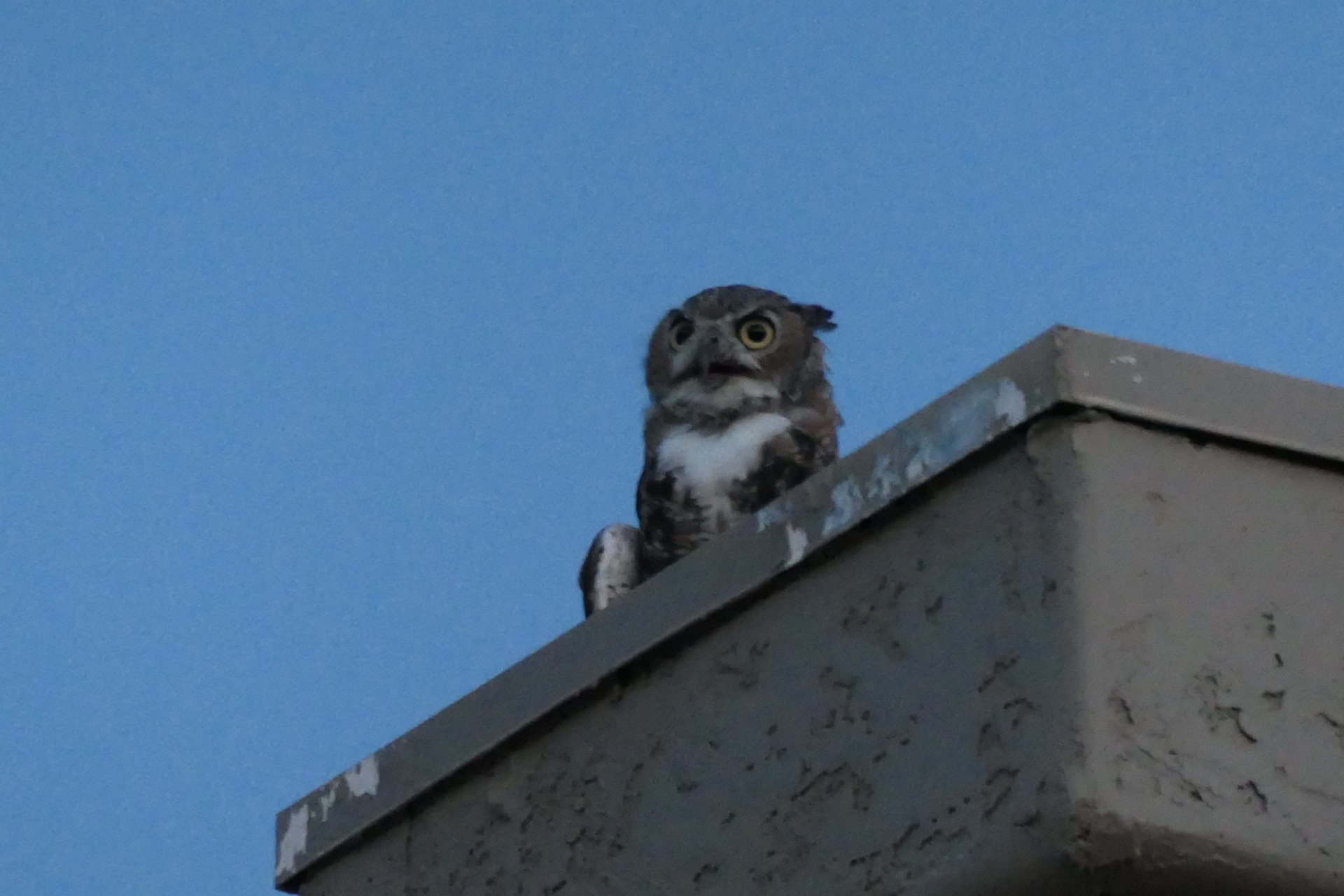
The third owl was perched on our neighbor’s chimney last night when I took the dog out. This great horned owl looked highly annoyed that we had come out just then. The perch gave her a great view of two backyards, either could offer prey. Or maybe was she contemplating a cool dip in the fountain?
What a gift to actually see these incredible predators in such close proximity to human homes. But with their crepuscular and nocturnal habits maybe there are more owls out there than we realize. I would guess that like other wild animals, owls are evolving to take advantage of small corners of suburban habitat that offer food and shelter.
A Nature Conservancy project has helped create a network of habitat gardens throughout the city of Shanghai, where 30 million people reside. The initial garden was built seven years ago on a construction waste site. The space is just 4300 square feet, but the native plants growing there now attract more than 40 species of birds, frogs and butterflies. The city has 33 greenspaces to date with plans for 10 more this year. This model for supporting biodiversity within high-density urban areas has been embraced by the community, as residents are involved in planning, building and maintaining the spaces. What a cool idea!
Monsoon....A Second Spring
By: Claudia Kirscher
Liberty Wildlife Volunteer
Our Arizona monsoons bring not only storms and rain. There are specialized breeding arrivals, peak hummingbird migration and sometimes rare visitors from Mexico.
Many desert mammals, birds, and other wildlife experience a secondary breeding and feeding boom due to abundant insects and new plant growth.
Rufous hummingbirds start moving through stopping to catch the seasonal burst of flowering desert plants.
Some Mexican rarities such as Plain-capped Starthroat, Berylline, and White-eared hummingbirds are more frequent during the monsoons.
Montezuma Quail are more vocal and active with the increase in food.
Sulpher-bellied Flycatchers breed in mountain canyons.
Dusky-capped Flycatchers move into higher woodlands with increased insect activity.
Botteri’s and Cassin’s Sparrows begin active breeding.
The Yellow-billed Cuckoo or “rain crow” arrives to coincide with the summer monsoons. An abundant food supply becomes available (caterpillars, cicadas, katydids) triggering a fast-breeding cycle (17 days from egg laying to fledge)
Nectar-feeding bats feast on summer-blooming desert agaves and cacti.
Yes, the desert comes alive during monsoon, our second spring!
More from Nature News
© 2026 Liberty Wildlife - Privacy Policy