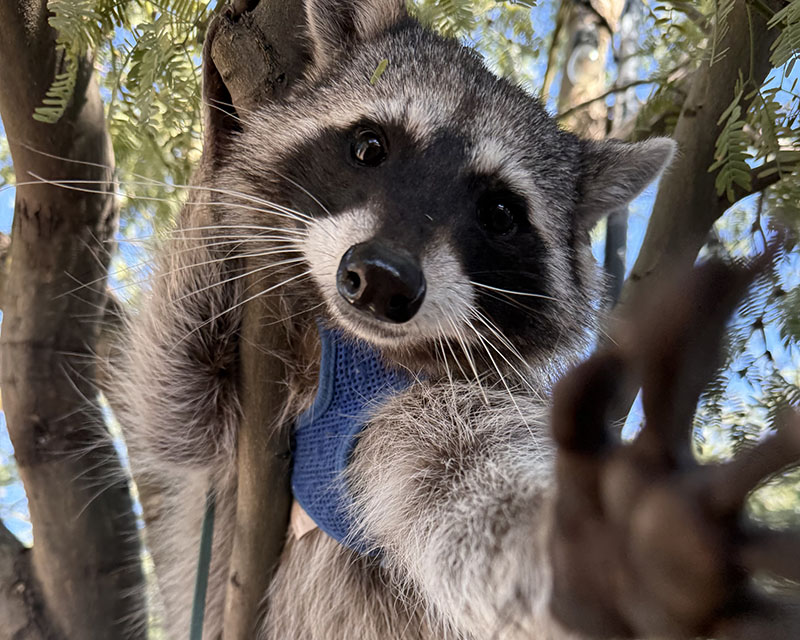
Benji
Raccoon Ambassador
Male
2025 / Juvenile
Orphan
About Benji
As an infant, Benji was found and taken by a homeless man. A kind member of the public later noticed this man with a baby raccoon and informed him that it needed to be taken to a wildlife rehab, but the man told him he would have to pay $100 to take the racoon. That kind member of the public willingly did so and immediately brought the baby raccoon here to Liberty. Benji was named after Benjamin Franklin, who is on the $100 bill.
Benji arrived at Liberty Wildlife on May 31, 2025. He was only a few weeks old and was dehydrated and in poor health. While our staff helped him recover, he bonded with them and has become a great addition to our Education Ambassador team.
As a rabies vector species, he is limited to only a few handlers, but he loves showing off to visitors who are amazed by his cuteness. It does need to be stated that they do NOT make good pets, though, and should never be fed in the wild.
Description
Raccoons are most known for the black “mask” that surrounds their eyes. They have white fur on their snout and surrounding the outer edge of that mask, and a thin black stripe that runs from their forehead head to their black nose. The rest of their fur ranges in color from gray to reddish brown depending on habitat. They have a bushy tail with 4 to 10 black rings. All of their paws have five digits, with the forepaws resembling a slender human hand. Average weight of 13.2 to 15.4 pounds (6-7 kg). Average length from nose to end of tail is 23 to 37 inches, tail accounting for 7.5 to 15.9 inches. Very stocky build, with some far north reaching 50% body fat.
Habitat
Prefer woodlands, also found in farmlands, suburbs, and urban areas. Can live about anywhere with a reliable water source.
Range
Southern Canada, United States, Mexico, northern parts of South American
Life Span
1-3 years, up to 20 years in captivity
Prey / Food
Omnivorous and opportunistic. Will eat fruits, nuts, insects, crayfish, rodents, frogs, fish, bird eggs, and occasionally passerine birds and carrion. Will also eat crops if available.
Babies / Nests
- Polygamous
- Breeding season is February to June
- Females will make a den, males increase range to search for females
- Males leave after breeding, females take full parental duty. Both may take multiple mates
- Gestation period is 63-65 days. Litters are 3-7 babies, 4 being average
- Kits open eyes after 18-24 days, weaned after 10 weeks, join mom to climb, forage, and hunt after 9-12 weeks
- Young will stay with mom through their first winter, become independent in spring
- Females mature after 8-12 months, males after 24 months
Native American Folklore
Coming Soon ...
© 2026 Liberty Wildlife - Privacy Policy