Gus
Bald Eagle Ambassador
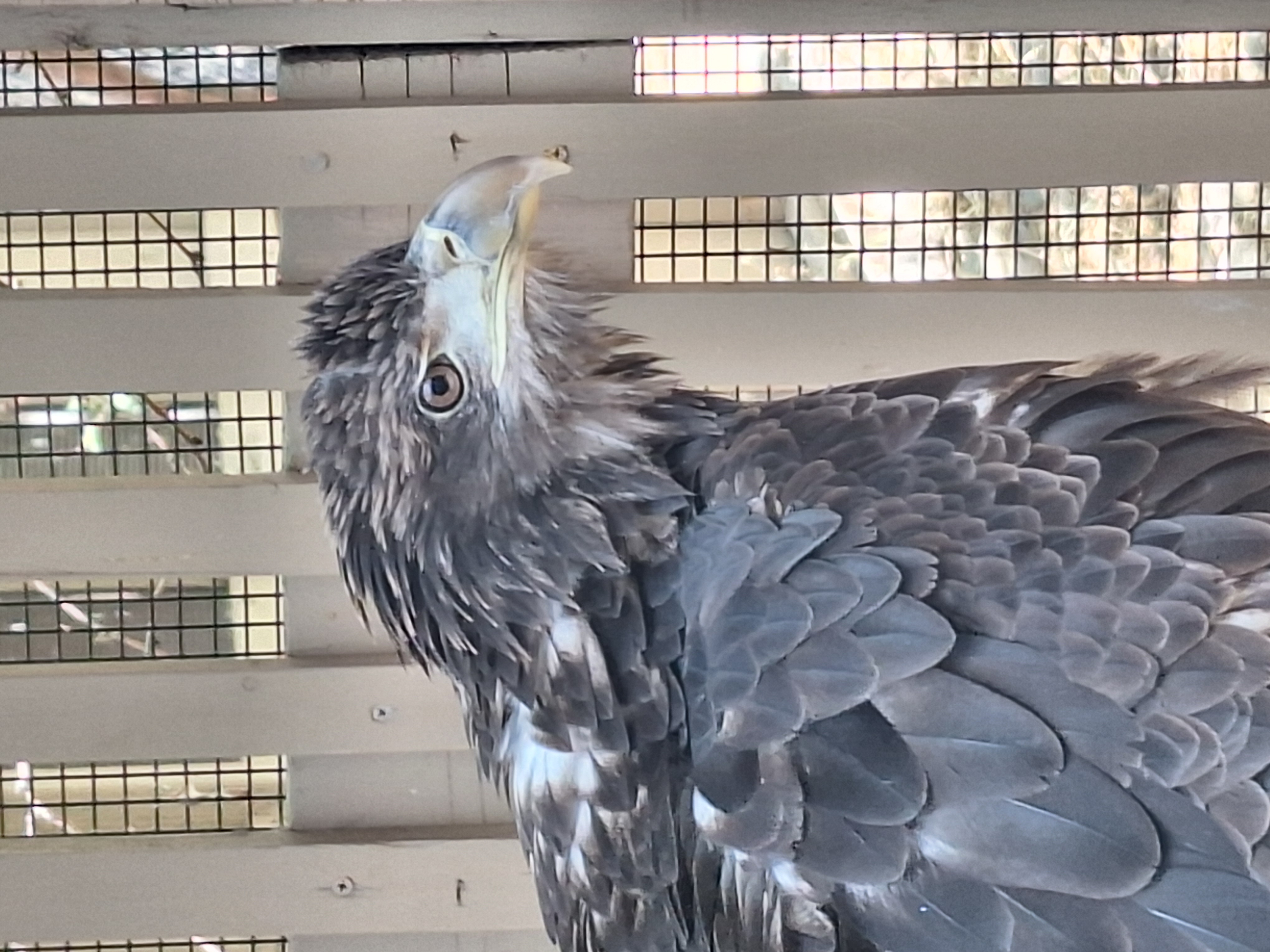
Male
2024 / Juvenile
Head trauma
About Gus
Gus arrived at Liberty Wildlife after he had fledged from his home nest. Observers saw him hit a wall and land on the ground. He was brought to our hospital and was in good body condition but had blood coming from the glottis, indicative of possible head trauma.
Radiographs revealed internal trauma. While he was being treated, it was noted that he had some difficulties with his vision, possibly from the head trauma as there were no signs of damage to the eyes themselves.
Gus is doing well at Liberty Wildlife as he now is in a static enclosure without other animals or obstacles to make it difficult for him with his vision issues.
Description
The bald eagle is a large raptor easily identified by their white heads and tails. Juveniles look more like golden eagles because they do not gain the trademark white head and tail until they reach five years old.
Habitat
Bald eagles nest in forested areas near large bodies of water. To perch they prefer mature coniferous or deciduous trees that give them a wide view of their turf.
Range
The bald eagle is found only in North America from Alaska through Canada and the United States to Northern Mexico
Life Span
In the wild bald eagles can live between 20-30 years. Some eagles in captivity have lived up to 50 years.
Prey / Food
Their primary food is fish (alive or dead) but they will also take waterfowl and other birds and mammals such as hares, rabbits, and rats. They have also been known to steal fish from humans and ospreys.
Babies / Nests
Eagles lay 1 – 4 eggs in a clutch but usually only have two. The eggs hatch in about 34 days. Juveniles fledge (learn to fly) in about 10 – 12 weeks. Bald eagle nests are large, built in the highest trees and near water.
Native American Connnections
Eagle with his powerful wings can effortlessly soar through the skies, evoking a sense of freedom and fearlessness. Eagle figures prominently as a Spirit Animal to nearly all Native people. In most tribes, Eagle is considered a medicine bird with supernatural powers and plays a major role in the religious ceremonies of those tribes.
Hopis consider Eagle as a guardian of the earth and a symbol of divine protection. They believe that Eagle’s sharp vision helps it detect any threats to the planet and its inhabitants. They also believe Eagle represents strength and courage. The Sioux believe Wambli (Eagle) is the strongest and bravest of all birds. For this reason, its feathers symbolize what is highest, bravest, strongest, and holiest. Eagle has strong medicine – it represents courage and bravery. To Apache’s the eagle is known as the master of the sky and represents fearlessness and determination. It is believed that by wearing eagle feathers or carrying an eagle feather fan, one can harness the bird’s strength and courage. These feathers are incorporated into ceremonial and dance regalia, serving as a reminder of the Eagle’s powerful qualities. The golden eagle, also known as the "war eagle," is associated with warriors and courage in battle. Golden eagle feathers earned by Plains Indians as war honors were worn in their feather headdresses. This practice continues to this day, and Eagle feathers are still given to Native soldiers returning from war or Natives who have achieved a great accomplishment The Hopi Eagle Dancer Kachina symbolizes strength, power, and freedom. It is revered as a messenger between the heavens and the earth, conveying prayers to the spiritual realm. The Eagle Dancer is believed to be close to the divine and serves as a protector. Eagle Dancer Kachina dolls hold a special place in the history of the Hopi. Their creation and use in rituals underscore Eagle’s significance in connecting the Hopi people with their cultural heritage. The most prized eagle feather for all Native peoples are those that come from the tail of a juvenile first year golden eagle. In this plumage the young golden eagle tail has a large white base with dark spotting. As the golden eagle matures the white base, and spotting disappears, and the tail feathers turn to a dark brown. These feathers are beautiful, spiritually powerful, and rare. Native Americans call these young juvenile golden eagles – Spotted Eagles.© 2026 Liberty Wildlife - Privacy Policy